Pre+Post Meeting Professional Development Workshops
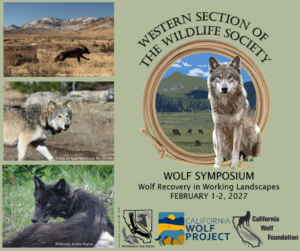
Wolf Recovery in Working Landscapes: Science for Conservation and Management
February 1-2, 2027
Chair: Kaggie Orrick, PhD
Assistant Chair: Eveline Larrucea, PhD
Special Guest Monday Evening: Doug Smith, PhD
Gray wolves are rapidly recolonizing California after nearly a century of absence, presenting both new conservation opportunities and complex management challenges across working landscapes. This two-day pre-symposium will bring together researchers, wildlife managers, producers, Tribal representatives, and conservation practitioners to share the latest science and management approaches supporting wolf recovery, as well as predator recovery more broadly. Sessions will explore wolf ecology, human dimensions, livestock coexistence strategies, policy, monitoring, and collaborative approaches to conservation, with an emphasis on translating science into effective management.
 ArcGIS Pro Online Workshop
- Tuesday, February 2, 2027 from 8am-5pm
- Instructor: Tom Dilts, University of Nevada, Reno
- Assistant Instructor: Nathan Jackson, University of Nevada, Reno
This full-day workshop is intended for all levels, beginner and intermediate. For beginners and those who have never used GIS it will serve as an excellent hands-on introduction. For long-time users of ArcMap, it will provide a quick start that will help them make the transition to ArcGIS Pro. This is a great workshop for those who dabble in GIS but want to do more or work more effectively. Throughout this workshop I will highlight the steps required to create data in the desktop environment and use the online and mobile environments for both sharing and collecting data.
About the instructor: Tom Dilts is a full-time research scientist in the Department of Natural Resources and Environmental Science at the University of Nevada Reno specializing in GIS and remote sensing applications for wildlife and natural resource management. He has taught GIS I: Geographic Information Systems and Science and Landscape Ecology.
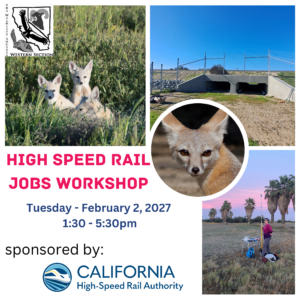
High Speed Rail Jobs Training
- Tuesday, February 2, 2027 from 1:30-5:30pm
- Moderator: Debra Hawk, California High Speed Rail Authority
The California High Speed Rail (HSR) is a long term construction project requiring numerous biologists to conduct preconstruction surveys as well as biological monitoring. This workshop is being held in conjunction with the HSR Authority and will provide biologists with an understanding of the specific criteria used by agencies to deem biologists qualified to work on this project. It will also allow participants to learn how to distinguish San Joaquin kit fox from other sympatric species, a key training need for biologists working on the project. The workshop is suitable for all levels of biologists including recent graduates and for those who are interested in doing field work, specifically hands-on biological monitoring.
 Wildlife Biologist Construction Awareness Training (WildC.A.T.)
- Tuesday, February 2, 2027 from 8:00am-12:30pm
- Moderator: Natalie Greer, AECOM
Wildlife biologists are often called on to provide technical expertise and implement protective measures on construction sites, but they rarely receive practical training in environmental permits or safety as they enter the workforce. This half-day workshop provides an introduction to construction monitoring for recent graduates, early career professionals, and regular construction monitors, and will be taught by experienced wildlife biologists, construction personnel, and health and safety officers.
Learn about the environmental permits that require construction monitoring, what to expect on construction job sites, situational awareness and health and safety basics, common environmental protection issues and Best Management Practices, effective communication techniques with construction crews, and useful tools of the trade. Upon completion of the workshop, attendees will receive a certificate of completion and helmet sticker that shows prospective employers and construction personnel in the field that they have attended WildC.A.T. training.
Wildlife Tracking Workshops with CyberTracker 
Well-rounded field skills and ecological literacy were once common among field biologists and emphasized in university curricula. In recent decades, however, these qualities and practices have rapidly diminished; numerous academic articles have highlighted this loss, warning of the impacts on future research, wildlife management, and conservation.
Instructor – Phil Johnston
There are two ways to learn about wildlife tracking in February!
(1) Wildlife Tracking Training
- Friday, February 5, 2027 from 12:30pm to 5:30pm
Join us for an introductory, no experience required, no-pressure tracking training session. Unlike the Saturday Certification, there is no evaluation component, test scores, or certificates involved in this low-stress afternoon of learning. Participants will spend an entertaining afternoon in the field with skilled trackers, identifying and discussing tracks and sign of any and all animals encountered. We’ll cover tips for ID, wildlife behavior, and how the process of reliable track interpretation works. This course provides guidance for methods and resources to effectively begin tracking on your own. Limited to the first 20 registrants.
(2) One-Day Certification with CyberTracker Conservation
- Saturday, February 6, 2027 from 8am to 4pm
Created alongside the San Trackers in South Africa, this process is designed to teach participants to track the way we’ve always learned: participants are asked to answer questions on a wide variety of tracks and animal sign (such as scat, feeding sign, burrows, etc) before the group discusses them at length. Though no prior experience is required to participate, please note that these evaluations are designed to test the current ability of participants, recording their answers right from the start. Each question is scored based on a difficulty scale, and participants will receive a certificate if enough points are earned through correctly answering the questions. This process effectively engages the core skills of competent trackers and the result is not just a significant upgrade in current ability—it provides participants a clear framework to keep improving in the field.